

Ivybridge
Community College
English
Head of Department: Lucy Pitcher
Welcome to the English Department at Ivybridge Community College.
The English Department at Ivybridge Community College is a passionate, dedicated and enthusiastic team; we are committed to supporting students to achieve their potential in their study of English and to prepare them for their chosen ventures beyond Ivybridge.
We aim to deliver a challenging and engaging curriculum that enables all learners to understand and analyse writers’ craft and utilise this knowledge and these skills in their own writing.
Our intent is to inspire a love of the subject, develop skills for life and enrich the students’ lives both in and out of the classroom.
Lessons and Student Sets
English Teaching Hours
| Year Group | Number of Lessons |
|---|---|
| Year 7 and 8 | 7 lessons per fortnight |
| Year 9 | 8 lessons per fortnight |
| Year 10 | 8 lessons per fortnight |
| Year 11 | 8 lessons per fortnight |
| Year 12 & 13 | 9 lessons per fortnight |
Year 11 Student Setting
| Set Name | Writer | Ability |
|---|---|---|
| MA | Maya Angelou | Upper (Grades 8–9) |
| BZ | Benjamin Zephaniah | Middle Upper (Grades 5–8) |
| JA | Jane Austen | Middle Upper |
| WS | William Shakespeare | Middle Lower (Grades 3–6) |
| CD | Carol Ann Duffy | Middle Lower |
| GO | George Orwell | Middle Lower |
| HL | Harper Lee | Middle Lower |
| KH | Khaled Hosseini | Middle Lower |
| WW | William Wordsworth | Middle Lower |
Year 10 Student Setting
| Set Name | Writer | Ability |
|---|---|---|
| MA | Maya Angelou | Mixed Ability |
| BZ | Benjamin Zephaniah | Mixed Ability |
| JA | Jane Austen | Mixed Ability |
| WS | William Shakespeare | Mixed Ability |
| CD | Carol Ann Duffy | Mixed Ability |
| GO | George Orwell | Mixed Ability |
| HL | Harper Lee | Mixed Ability |
| KH | Khaled Hosseini | Mixed Ability |
Years 7–9 Student Setting
| Set Name | Writer | Ability |
|---|---|---|
| MA | Maya Angelou | Mixed Ability |
| BZ | Benjamin Zephaniah | Mixed Ability |
| JA | Jane Austen | Mixed Ability |
| WS | William Shakespeare | Mixed Ability |
For further information, please refer to the WeST English Curriculum Overview document or the Ivybridge Community College Year 7–13 Curriculum Map available below.
Assessment and Marking
English Department Marking Policy
Years 7–9
Teachers should:
- Engage in comparative judgement (National Mentoring Mission) twice a year (except Year 8), using data to support student progression and inform planning.
- Provide class feedback on set tasks (minimum of three per Standard of Learning).
- Allow sufficient time for students to respond to and improve their work based on feedback.
- Teach students how to give effective peer and self-assessment.
Students should:
- Act on class feedback by improving work (using purple pen).
- Regularly check classwork for key spellings.
- Provide effective self and peer assessment to support improvement.
Parents should:
- Support students by reading through work, proofreading, and checking spelling, punctuation, and grammar.
- Discuss with students how they have improved or could improve their work.
Years 10–11
Teachers should:
- Engage in standardisation and moderation activities to ensure consistent and accurate marking.
- Provide class feedback on set tasks (minimum of three per Standard of Learning).
- Allow sufficient time for students to respond to and improve their work based on feedback.
- Teach students how to give effective peer and self-assessment.
Students should:
- Use assessment feedback to improve their work.
- Act on class feedback by improving work (using purple pen).
- Regularly check classwork for key spellings.
- Provide effective self and peer assessment to support improvement.
Parents should:
- Support students by reading through work, proofreading, and checking spelling, punctuation, and grammar.
- Discuss with students how they have improved or could improve their work.
Years 12–13
Teachers should:
- Mark one practice question per half-term in line with Academic Opportunities and the mark scheme.
- Provide regular class feedback (minimum of twice per term).
- Give students time to reflect on feedback and improve their work.
- Provide regular verbal feedback during class discussions and activities.
- For NEA: provide question-based feedback on two full drafts.
Students should:
- Use teacher feedback to develop and improve their work regularly.
- Continue to develop classwork independently, responding to both written and verbal feedback.
- For Non-Examination Assessment (NEA): use feedback to redraft their work twice.
Parents should:
- Discuss assessment feedback with students to strengthen their understanding of how to improve.
Home Learning
Years 7–10
Centrally Set Home Learning:
- Weekly Knowledge Quiz: a Microsoft Form set centrally on Class Charts and stored for teachers to analyse.
- Weekly Reading Home Learning: responses submitted via Microsoft Form, with a text booklet provided to students.
Independent Home Learning:
- Use of a self-testing toolkit to revise core knowledge.
- Independent reading.
Year 11
Centrally Set Home Learning:
- Weekly Knowledge Quiz: a Microsoft Form set centrally on Class Charts and stored for teachers to analyse.
Teacher Set Home Learning:
- Knowledge quizzes.
- Revision tasks.
- Thesis statements and essay planning.
Independent Home Learning:
- Use of a self-testing toolkit to revise core knowledge.
- Independent reading.
Disciplinary Reading
What does Disciplinary Reading look like in English?
General Reading
- The curriculum provides frequent exposure to texts in lessons – fiction and non-fiction – that are both engaging and challenging, exposing students to a selection of the best that has been thought and written. This allows students to accrue ‘reading miles’.
- This reading is supported and extended beyond the classroom by directed homework reading of thematically relevant short articles/extracts for comprehension (assessed through online Multiple Choice Questions).
- Reading tasks systematically support students to set a clear goal for reading (e.g. through a question that demands high-level comprehension of the text).
- Reading tasks initially prioritise general reading over analytical reading on the basis that it is very difficult to analyse a text we only partially comprehend.
- This is particularly supported through the fast reading of literature texts – focusing on general comprehension – (see Westbrook et al.)
- We recognise that adjusting the way in which students access a text can adjust the inherent challenge presented by that text. For example, students can access far more challenging texts with support – such as when the texts are read aloud and/or comprehension is scaffolded by the teacher – than they can independently. Via this ‘sliding scale’ of support, we are able to pitch challenge appropriately.
- When reading aloud with students, 'Control the Game’ is used in order to ensure that reading is meaningful and highly leveraged (i.e. that passivity is avoided and as many students as possible are actively engaged with the reading process).
- Reading and writing are taught as two sides of the same coin so that, for example, knowledge of how to read a particular text type provides insights into how to write similar texts (see comprehension components above). Learning how to write a particular text type, meanwhile, is used to help students to read texts as writers and to be alert to the ways in which they have been crafted.
- Using Frayer models to explicitly teach new vocabulary allows us to teach the explicit meaning of language.
Reading as an English expert (Analytical Reading)
Analytical reading is the process of not taking texts at face value, but rather interrogating them deeply as constructs to explore what the writer is trying to achieve; how they do this; and why they do this. Crucially, it is a process which allows us to step back from texts in order to objectively question them and to judge them, without getting lost in our subjective experience of them. It is this type of reading that is distinct to the discipline of English – both language and literature – and which students must master if they are to read like English experts.
The curriculum:
- supports students to apply the core elements of the curriculum when reading analytically: thinking of text as a construct; thinking about GAT-C, the specific elements of crafting that the writer has used: CLS (content, language, structure).
- supports the explicit teaching of the components that make up these composites (e.g. elements of the writer’s craft; words, phrases and sentence structures to support comparative thinking).
- The curriculum is text-rich, providing extensive material for practice.
- Weekly homework reading tasks also contain questions that require students to read like English experts e.g. thinking about the writers’ intentions and how the text is crafted.
- It provides examples of experts reading like English experts (e.g. other readers’ interpretations).
- As with general reading, analytical reading and writing are taught as two sides of the same coin.
- It teaches students writing and speaking structures to support analytical reading (and thinking).
Reading for Pleasure
First and foremost, we support reading for pleasure by helping our students to become better readers who are less likely to view reading negatively because of the frustration it entails for them. In addition to this, we actively use lessons to 'light the fire’ of interest:
- We plan a rich and engaging curriculum that makes students want to read around it.
- We choose texts for students to read and study that have intrinsic value.
- By prioritising general comprehension, we work to ensure that students don’t become detached from texts.
- We model curiosity and interest in the texts we are studying.
- We often read texts aloud and do so with passion and energy to bring them to life for our students.
- We talk about books we like and, in particular, systematically recommend thematically relevant texts (please see 'Specific Texts read as part of the Curriculum' section below).
Beyond lessons, we further support reading for pleasure through the following:
- The texts provided for homework tasks are also chosen for their intrinsic value.
- We run reading challenges to engage students with texts outside the classroom.
Where are we?
Where are we?
The students are clearly being exposed to challenging texts within their English lessons and both students and teacher voice shows a positive response to the majority of these texts. (In particular, the Year 7 & 8 students talk especially positively about ‘Animal Farm’.)
Fast reading of full literature texts (with a focus on comprehension) is a clear curriculum strategy and is supported by the Standard of Learning resources and Medium Term Plans.
On the whole, this has been met positively by teachers and students and we can see a real improvement in the students’ knowledge of the text (especially lower ability and SEND students).
Reading as an English expert is an overarching principal of our WeST English curriculum and students are becoming far more adept at speaking and writing about writers’ craft and text as a construct.
How best to format the reading H/Ls across year 7-10 is a current focus for WeST HoDs meetings, English Leadership meetings and department meetings.
Each term we have tried different formats and will use student and teacher feedback at the end of the year to decide which approach is model engaging and effective.
Specific Texts read as part of the Curriculum
Year 7
Term 1:
- Extracts and short texts from the Gothic genre
Term 2:
- Animal Farm
- Non-fiction extracts and articles
Term 3:
- Extracts from Romeo and Juliet
- A range of poetry
Year 8
Term 1:
- In the Sea, There Are Crocodiles
Term 2:
- Extracts from Much Ado About Nothing
Term 3:
- Non-fiction extracts
Year 9
Term 1:
- Lord of the Flies
- Power and Conflict Poetry Anthology
Term 2:
- Short stories / fiction
- Dystopian extracts
- Power and Conflict Poetry Anthology
Term 3:
- An Inspector Calls
- Power and Conflict Poetry Anthology
Year 10
Term 1:
- A Christmas Carol
- Power and Conflict Poetry Anthology
Term 2:
- Macbeth
- Power and Conflict Poetry Anthology
Term 3:
- Fiction extracts
- Three non-fiction articles to support discursive writing
Year 11
Students read a range of fiction extracts and non-fiction texts to support their English Language study.
These texts come from a variety of eras (from 19 Century to 21 Century) and we aim to share a range of diverse voices with the students.
Texts are chosen for their literary merit and high-quality vocabulary as well as how easily they allow students to explore crafting effectively in their analytical reading.
Destination Overview (KS3)
Where do we want to be at the end of Key Stage 3
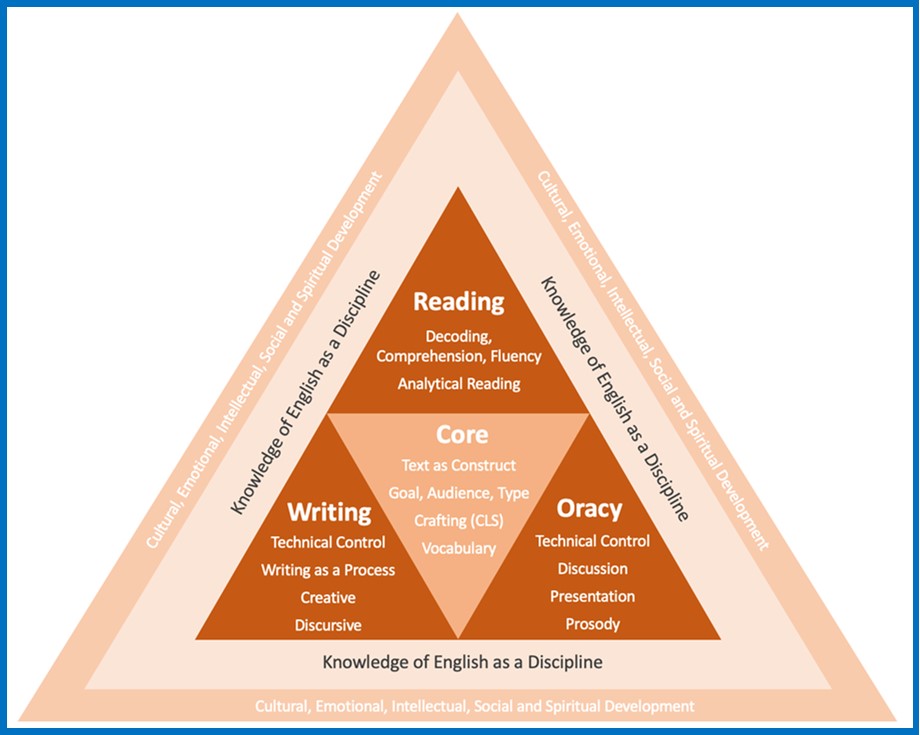
We recognise the importance of Key Stage 3 as a foundation for Key Stage 4. It is here that students have the opportunity to hone their understanding of English as a discipline and their control of reading, writing and oracy generally.
Indeed, we understand that if these basic building blocks are not secure at this point, students will find Key Stage 4 more challenging, and that GCSE success is ultimately dependent upon mastery of these modalities.
As such, our aim for the end of KS3 is for all students to be secure in the main strands of our curriculum in order that:
- They know what English is, the knowledge that constitutes it, and the inherent value of it (at best love; at worst appreciate).
- They are confident and competent (or better) readers, writers and speakers generally.
- They are able to read, write and speak in a disciplinary way: reading analytically; writing creatively and discursively; and speaking like English experts.
- They have been supported to develop culturally, emotionally, intellectually, socially, spiritually and creatively.
Core
- Know that texts are constructs.
- Know what goal, audience and type are.
- Know what crafting is and the main elements of crafting
(CLS – Content, Language, Structure). - Know the key content, language and structure tools available to support effective crafting.
- Know that goal, audience and type influence crafting (GAT-C).
- Know that GAT-C can help us as readers (to think about the crafting choices writers have made) and as writers and speakers (to think about the crafting choices we will make ourselves).
Reading
- Read at – or above – an age-appropriate level.
- Know that texts are constructs and know how to use GAT-C to dissect these.
- Know what it means to read like an English expert (analytical reading).
- Know a range of text types (both fiction and non-fiction) and the conventions that underpin these.
- Be able to read analytically using this knowledge.
Writing
- Write at – or above – an age-appropriate level.
- Be able to write fluently with full technical control of spelling, punctuation and grammar.
- Know that writing is a process, what the stages in this process are, and both how and when to deploy these stages.
- Know that texts are constructs and how to use GATC to produce these.
- Know what creative writing is broadly, what it aims to achieve and what the ingredients of quality creative writing are.
- Within creative writing, to know what descriptive writing, narrative writing and experiential non-fiction are and what constitutes quality for each of these.
- Know what discursive writing is broadly, what it aims to achieve and what the ingredients of quality discursive writing are.
- Within discursive writing, to know what essay writing, opinion articles and persuasive speeches are and what constitutes quality for each of these.
- Be able to write high quality descriptive writing, narrative writing and experiential non-fiction.
- Be able to write high quality essays (especially literature essays), opinion articles and persuasive speeches.
Oracy
- Know how to speak in an academic context (standard English, tone, language).
- Know that spoken texts are constructs and how to use GAT-C to adapt talk.
- Know what prosody is and how prosodic elements can shape meaning.
- Be able to apply knowledge of prosody to their own talk (including when reading aloud).
- Know what discussion is and what the ingredients of quality discussion are.
- Be able to engage in high quality discussion.
- Know what presentations are and the ingredients that lead to quality.
- Be able to produce high quality presentations.
English as a Discipline
- Know the substantive and disciplinary knowledge specific to English as a domain.
- Know why English matters.
- Know what English is and how the different modalities of it fit together and overlap.
- Know what the main composites within English are (e.g. discursive writing) and what quality looks like for each of these.
- Know what literature is.
- Know what disciplinary reading, writing and speaking in English is.
- Be able to apply the knowledge above.
For more information, please contact the College here: